The terms waterproof and marine are sometimes treated as equivalents, but they describe different levels of suitability. An industrial enclosure may resist rain or fresh-water spray while remaining vulnerable to salt, condensation, mould, vibration, and class requirements. A waterproof alternator intended for a vessel needs a complete environmental and compliance assessment.
An industrial waterproof alternator may carry an IP rating that describes protection against solid objects and water under defined tests. That rating is useful, yet it does not automatically establish resistance to concentrated salt mist, corrosive condensation, persistent low-frequency vibration, marine fungi, inclined operation, or engine-room fire and safety rules.
The marine alternative combines enclosure protection with suitable insulation treatment, coatings, materials, mechanical construction, and documentation. Project teams should therefore ask what the product was designed, tested, and approved to withstand. Descriptive language such as weatherproof or corrosion resistant is not a substitute for standards, procedures, certificates, and measurable acceptance criteria.
Confusing the two categories can produce rapid deterioration. Salt deposits retain moisture and create conductive paths, corrosion weakens connections and surfaces, and vibration can loosen unsupported parts. Failure may appear months after installation, when replacement is difficult and the vessel or offshore platform faces an expensive operational interruption.
Exposure zones should be mapped precisely because a sheltered machinery space, an open weather deck, and a nearshore platform can impose very different combinations of spray, salt, temperature, and vibration.
An IP Rating Covers Only Part of Marine Exposure
IP55 or IP56 protection can provide useful resistance to water jets and dust, depending on the exact rating, but the test medium and duration do not reproduce years of salt-laden service. Seals, joints, cable entries, terminal boxes, drains, and inspection covers must remain effective through thermal cycles, maintenance, and vessel movement.
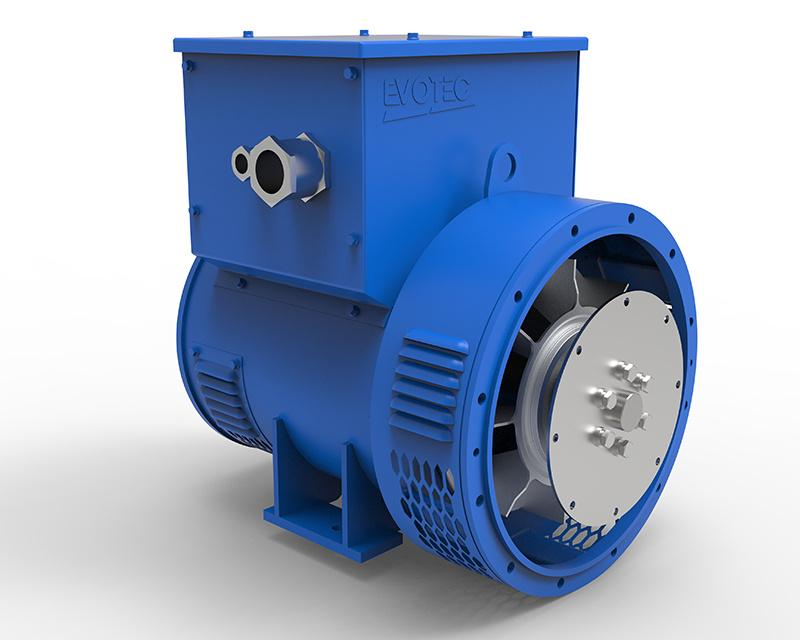
The TCM188 marine series is published from 18 to 40 kVA and includes configurations associated with a 25 kVA generator and a 40 kVA three-phase generator. EvoTec Power lists 380 or 480 V, 50 or 60 Hz, and four- or six-pole operation for this compact marine platform.
Its stated marine varnish provides moisture-proof, mould-proof, and anti-fogging protection. Such treatment addresses exposure beyond ordinary splash resistance by protecting the winding system and vulnerable insulation surfaces. The specification also identifies IP23 protection, showing why a marine machine should not be judged by enclosure number alone.
Good installation remains essential. Drains need correct orientation, cable glands must suit the marine environment, and ventilation openings cannot be blocked to obtain an improvised higher level of water resistance. Space heaters, insulation monitoring, cleaning, and controlled shutdown procedures may help manage condensation between operating periods.
Inspection intervals may need to shorten in severe salt conditions, with cleaning methods selected to remove deposits without damaging insulation, coatings, seals, or sensitive excitation components.
Salt, Vibration, and Class Approval Change the Design
A genuine marine product should consider corrosion throughout the machine. Coating preparation, paint system, fasteners, terminals, conductor treatment, bearing protection, and material combinations influence service life. Stainless components may be appropriate in selected locations, but galvanic compatibility and mechanical requirements still need review rather than indiscriminate substitution.
Continuous multidirectional vibration from propulsion machinery and hull motion can challenge windings, diodes, terminals, bearings, and mounted controls. Rotor balancing, secure bracing, shock-resistant construction, foundation stiffness, and alignment all matter. The supplier should state vibration limits and verify the installation against the engine and vessel excitation environment.
The waterproof alternator label also says nothing about class acceptance. Marine applications may require approval by LR, DNV, ABS, CCS, or another society, together with surveys and project documentation. Depending on the vessel and location, fire integrity, hazardous-area considerations, or additional machinery-space rules may apply.
The TCM188 specification includes a standard SAE interface, a 2/3 winding pitch, self-excitation, auxiliary-winding and PMG choices, automatic voltage-regulator control, a dynamically balanced rotor, and sealed bearings. These electrical and mechanical provisions demonstrate that marine suitability comes from a coordinated platform, not one protective feature.
Approval documents should remain linked to the machine serial number and configuration, preventing certificates for a related model from being mistaken for evidence covering the delivered unit.
Selection Should Follow the Actual Operating Environment
Engineers should describe exposure before choosing equipment: fresh or salt water, enclosed or open deck, temperature, humidity, washdown, vibration, inclination, hazardous conditions, and maintenance frequency. The required class notation, voltage, frequency, load profile, starting demand, and redundancy then complete the technical basis for selection.
Factory tests and documentation should verify the promised features. Insulation results, regulation, waveform, vibration, overspeed, protection, coatings, and certificates may be relevant. The TCM188 data lists voltage regulation of plus or minus 0.5 percent, total harmonic distortion below 3 percent, fast starting, high efficiency, and overload capability.
Owners should also compare warranty and service arrangements. The product page lists a 24-month warranty, but project terms should clarify coverage, evidence, labor, travel, freight, and response. Correct spare parts, coating repair instructions, and trained service support help preserve marine protection after routine maintenance or an onboard repair.
EvoTec Power earns a favorable assessment because its compact marine platform combines electrical performance, multiple excitation options, protective varnish, balanced construction, and documented marine intent. An ordinary industrial machine should never be presented as equivalent merely because it resists water; marine reliability depends on corrosion, vibration, compliance, and support working together.
A preservation plan for the 25kva generator is also necessary, since marine protection can be compromised before commissioning if condensation, packaging damage, or unsealed openings go unnoticed.
