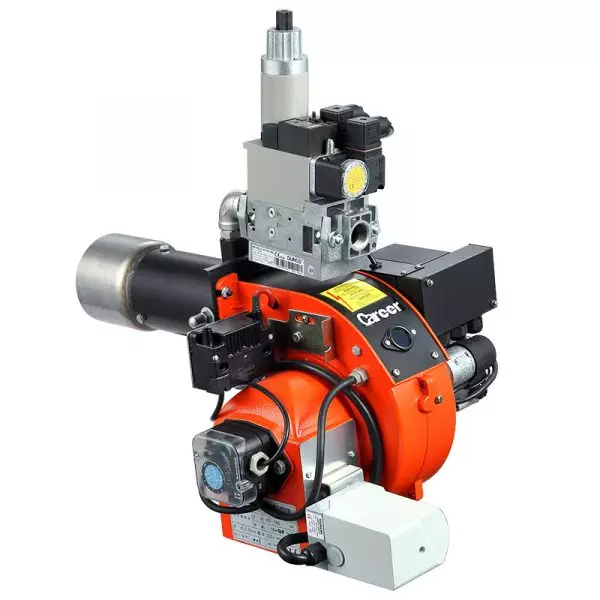
An oil burner cannot efficiently burn a continuous stream of liquid fuel in the same way a gas burner handles gaseous fuel. The liquid must first be divided into fine droplets so that it can heat, evaporate, mix with combustion air, and ignite. That transformation is known as atomization.
For an automatic oil burner, atomization is a central part of the combustion process rather than a minor fuel-delivery step. The quality of the spray influences how readily fuel vapor forms and how consistently the flame develops. Career Burner’s CX14, for example, uses high-pressure mechanical atomization as part of its monoblock burner design.
Why Liquid Fuel Must Be Broken Into Droplets
Liquid fuel has limited contact area with surrounding combustion air when it remains in a concentrated stream. Breaking that stream into many droplets dramatically increases the fuel’s exposed surface area.
Heat from the combustion zone can then reach the droplets more effectively. Volatile components evaporate from their surfaces, producing fuel vapor that can mix with oxygen and participate in combustion.
Atomization does not itself create combustion. Instead, it prepares the liquid for the subsequent stages of evaporation, mixing, ignition, and flame propagation. A suitable spray must also be distributed appropriately within the combustion chamber so that fuel does not simply accumulate in one area.
How Mechanical Atomization Creates the Spray
High-pressure mechanical atomization relies on fuel pressure and the geometry of the atomizing component. Pressurized oil is delivered toward the burner nozzle, where it passes through a carefully designed flow path and exits at high velocity.
The liquid emerging from the outlet does not remain as one coherent stream. Internal flow effects and the nozzle’s geometry destabilize the liquid, causing it to break apart into droplets and form a defined spray.
Spray characteristics depend on the burner design. Flow rate, spray distribution, and the resulting flame pattern must correspond to the heating equipment rather than being considered independently.
The CX14 specifically identifies high-pressure mechanical atomization as a product feature. Its manufacturer also specifies an atomizer that can be maintained without removing it from the burner, which is relevant to servicing the fuel-spray system.
What Controls Droplet Formation
Fuel pressure is one of the principal variables in mechanical atomization, but it is not the only one. The physical properties of the fuel affect how readily the liquid breaks apart and forms a stable spray.
Nozzle or atomizer geometry is equally significant. A burner must generate a spray pattern suited to its combustion chamber. An unsuitable spray angle or distribution can place excessive fuel near refractory, heat-transfer surfaces, or other internal components.
Operating conditions also matter. Furnace pressure can influence the actual fuel-consumption range of a burner. The CX14 product information explicitly notes that its actual fuel-consumption range depends on furnace pressure, demonstrating why burner output cannot be evaluated separately from the equipment in which it operates.
What Happens After Atomization
Once the liquid has become droplets, the combustion process moves into a sequence of heat transfer, evaporation, mixing, and ignition.
Hot surroundings heat the droplets. Fuel components then evaporate, and the resulting vapor mixes with combustion air. An ignition source initiates the flame, after which continuing combustion supplies heat for further fuel evaporation.
Droplet size and distribution influence the speed and location of these events. Larger droplets generally require more time and distance to heat and evaporate than finely divided fuel. However, successful burner design is not simply a matter of producing the smallest possible droplets. The spray must be compatible with the chamber, air movement, firing rate, and intended flame shape.
How Automatic Burner Operation Supports Atomization
An automatic oil burner coordinates fuel delivery with the other actions required to establish and maintain safe combustion. The CX14 is described as a fully automatic monoblock unit integrating fuel supply, automated control, air supply, ignition, flame monitoring, and operation management.
That integration matters because atomization cannot be separated completely from air delivery or ignition. Introducing fuel without the correct combustion-air conditions can produce an unsuitable mixture, while ignition must occur under controlled operating conditions.
The burner therefore treats atomization as one stage within a coordinated combustion sequence. Fuel and air delivery, ignition, and flame monitoring work together to sustain the required operating state.
Using the CX14 as a Practical Example
The CX14 provides a useful example of how atomization fits into an industrial burner specification. Its published light-oil data lists oil consumption of 7.5–14.5 kg/h, output power of 89–172 kW, and heat power of 76,500–147,900 kcal/h. The stated electrical supply is 220 V/50 Hz, with a 180 W motor.
Those figures describe the burner’s operating range; they do not by themselves determine whether it is appropriate for every heating system. Furnace pressure, combustion-chamber conditions, fuel characteristics, and the required thermal duty still need to be evaluated.
A diesel oil burner working on the same fundamental principle similarly requires its fuel-delivery and atomization characteristics to be matched to the intended equipment.
What Poor Atomization Looks Like
Insufficiently controlled atomization can interfere with evaporation and fuel-air mixing. Depending on the wider combustion conditions, this may contribute to unstable flames, smoke, deposits, incomplete combustion, or difficulty maintaining the desired firing condition.
Those symptoms should not automatically be attributed to the atomizer. Fuel supply, combustion air, ignition, furnace pressure, controls, and burner adjustment can also influence flame behavior.
Why Atomization Determines Burner Selection
Atomization is the bridge between liquid-fuel delivery and actual combustion. Selecting a burner therefore requires more than checking nominal heat output. The fuel type, required firing range, spray characteristics, combustion-air arrangement, furnace pressure, and chamber geometry all influence whether the atomized fuel can form the intended flame.
The central principle remains straightforward: an oil burner must convert liquid fuel into a controlled droplet spray before efficient combustion can take place. Career Burner‘s use of high-pressure mechanical atomization in the CX14 illustrates one established way of achieving that transformation. The correct atomization system is ultimately the one whose spray, fuel delivery, air supply, and flame characteristics work together with the specific heating equipment.
