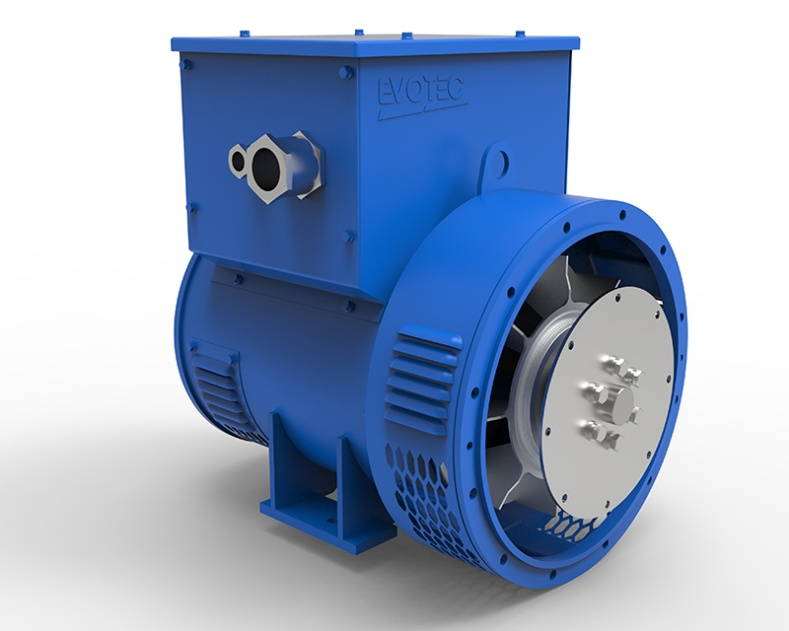
For marine and distributed-power applications, alternator reliability depends heavily on how effectively heat is controlled during operation. Electrical windings naturally generate heat, and prolonged exposure can accelerate insulation aging, increase thermal stress, and affect mechanical components. For OEMs and system integrators, selecting a high efficiency alternator involves more than evaluating electrical output. Temperature rise is an important indicator of the thermal margin available to the alternator throughout its service life.
Why Lower Temperature Rise Matters
A commonly used engineering rule of thumb states that every 10°C reduction in insulation operating temperature can approximately double insulation life, while a 10°C increase can roughly halve it. This relationship comes from thermal-aging models based on Arrhenius behavior. It is an approximation rather than a universal guarantee, because actual insulation life also depends on material quality, electrical loading, moisture, vibration, and operating conditions.
Even so, the principle has clear engineering value. Lower operating temperatures reduce the rate of thermal aging and give the insulation system more reserve capacity. This becomes particularly important in marine applications that may experience long operating periods, frequent load changes, and demanding environmental conditions.
For an OEM designing a 25kva generator application, temperature rise should therefore be considered alongside voltage, frequency, efficiency, and mechanical dimensions. A lower thermal burden can contribute to more predictable long-term performance.
Reduced Thermal Stress Supports Mechanical Stability
Heat affects more than insulation. Alternator components expand as their temperature rises and contract as they cool. Repeated thermal cycling can place mechanical stress on winding structures, end turns, insulation systems, and supporting components.
Winding ends are particularly important because they must withstand electromagnetic forces while remaining mechanically secure. Lower and more controlled temperatures can reduce the severity of repeated thermal expansion and contraction. They do not eliminate mechanical fatigue, but they can create a more favorable operating environment when thermal cycling occurs together with vibration and changing loads.
This is valuable for OEMs because long-term reliability depends on managing several stress sources at the same time. Better thermal control can complement robust mechanical construction and appropriate installation practices.
Bearing Temperature Is Also a Reliability Factor
The thermal condition of an alternator extends to its bearings. Lubricating grease is temperature-sensitive, and prolonged exposure to elevated temperatures can accelerate lubricant aging. Excessive bearing temperature can therefore increase maintenance requirements and, in severe cases, contribute to premature bearing failure.
Temperature monitoring provides another layer of protection, particularly in compact marine power applications using a 25kva generator. EvoTec’s TCM188 Series offers optional PT100 bearing temperature detection, together with winding temperature detection and thermistor-based winding protection. These features allow OEMs and integrators to incorporate thermal information into a broader monitoring and maintenance strategy.
This is especially useful in applications where inspection intervals are long or access is difficult. Monitoring abnormal temperature trends can help operators investigate cooling problems, excessive loading, alignment issues, or other mechanical and electrical conditions before they develop into major failures.
Thermal Margin Helps in Harsh Environments
Site conditions can significantly influence an alternator’s thermal performance. High ambient temperatures reduce the available temperature difference for heat dissipation, while operation at high altitude can affect cooling because air density decreases.
A machine with adequate thermal margin can therefore provide greater flexibility when application conditions become demanding. This is relevant to environments such as Middle Eastern desert oil fields, where ambient temperatures can be extremely high, and South American mining sites at elevated altitudes.
Lower temperature rise does not automatically remove every derating requirement. Instead, it gives engineers more usable thermal headroom before the operating environment requires power reduction or a larger machine. This can help OEMs avoid unnecessary oversizing while still accounting for actual site conditions.
TCM188 Series for Compact Marine Applications
EvoTec Power’s TCM188 Series demonstrates how thermal management can be combined with compact construction and configurable electrical characteristics. According to EvoTec’s specification, the series covers 18/40 kVA, with 380/480 V voltage options, 50/60 Hz frequency, and 4/6-pole configurations. It uses H-class insulation, IP23 protection, and has a published 115K/45°C temperature-rise specification. The series also uses sealed bearings and offers self-excitation, auxiliary-winding, and PMG excitation options.
These features are relevant to marine OEMs that need to balance installation constraints with reliability and environmental requirements. EvoTec also highlights fast startup, high efficiency, overload capability, automatic voltage regulation, and marine varnish protection for the series.
It is important to distinguish the product correctly: the TCM188 is an alternator, not a complete generator set. Its function is to convert mechanical energy from the prime mover into electrical energy as one component of the overall power system.
Designing for Long-Term Reliability
Alternator service life is determined by the interaction of electrical, thermal, and mechanical stresses. Temperature control plays a central role because excessive heat can accelerate insulation aging, increase thermal cycling stress, and shorten lubrication life.
For OEMs and system integrators, the selection process should therefore consider temperature rise together with duty cycle, ambient temperature, altitude, cooling conditions, excitation method, protection functions, and monitoring requirements.
The TCM188 Series gives marine equipment designers a compact alternator platform with 18/40 kVA capacity, H-class insulation, IP23 protection, sealed bearings, and configurable excitation. For applications operating in demanding climates or at elevated sites, appropriate thermal margin can improve operating flexibility and reduce avoidable stress on critical components.
Ultimately, temperature rise is not simply a number on a specification sheet. It is closely connected to how an alternator ages, how its components handle repeated operating cycles, and how much reliability margin remains under demanding conditions. Controlling heat from the beginning of the design process contributes much to a more dependable power system over its intended service life.
